
Board Pack (Riley)
Crawl / Walk / Run Strategy
The Days 1-90 / 91-180 / 181+ phasing of the roadmap.
Crawl / Walk / Run Strategy (Riley)
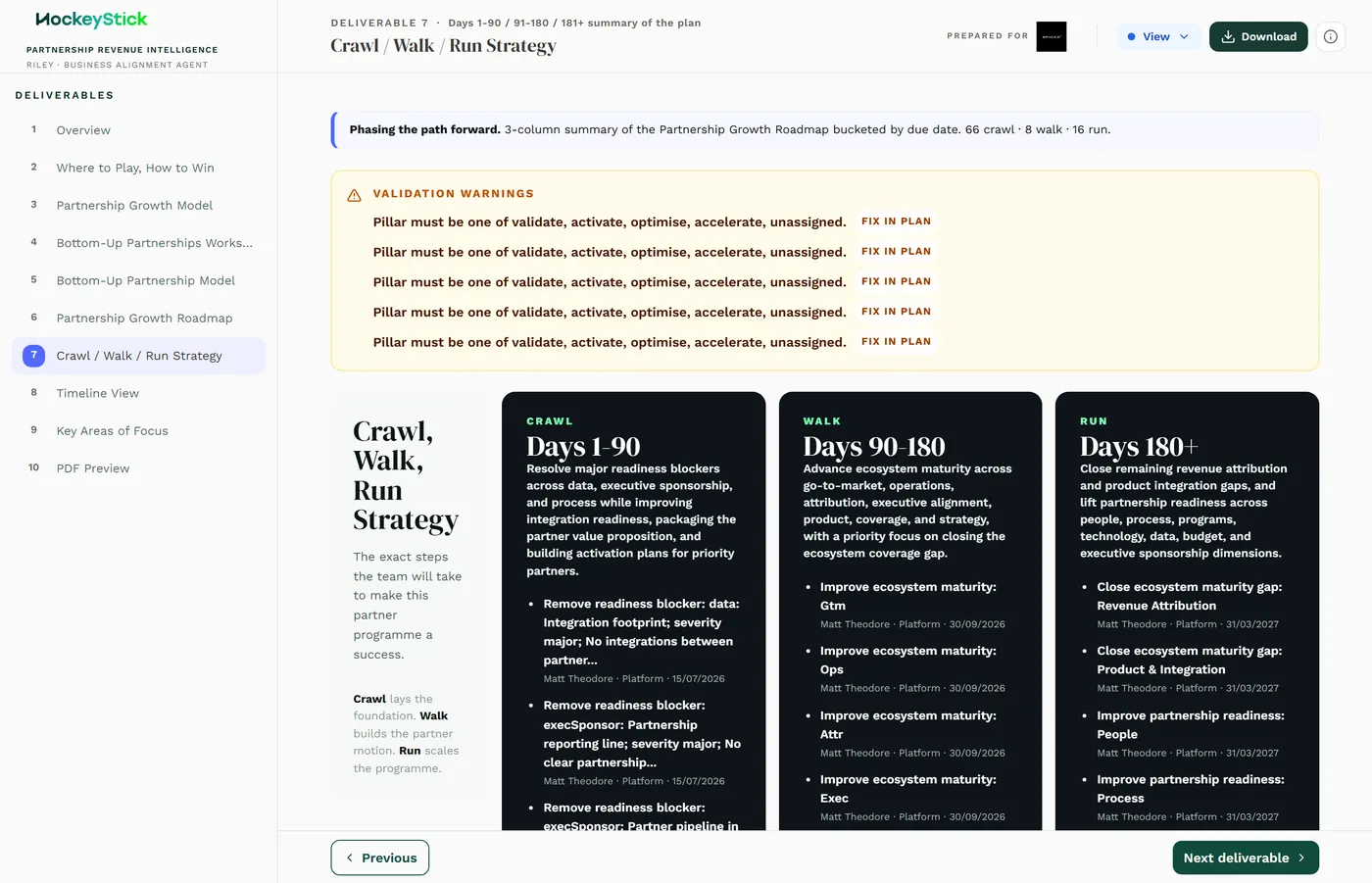
The Crawl / Walk / Run page phases the plan into three horizons, so the client can see what happens first, what follows, and what waits until the foundations are in place.
What it is
A REPORT deliverable in the Board Pack (Partnership Playbook). It is derived, not authored: it reads from the Partnership Growth Roadmap and groups the roadmap tasks into three timing phases. You do not edit this page directly. To change what falls into a phase, change the task dates and sequencing in the roadmap and this page rebuilds. The page is headed "Phasing the path forward."
What each section means
The page shows three phases, each holding the roadmap tasks whose timing lands in that window:
- Crawl, Days 1-90. The first horizon. This is where the foundational work
lands: the tasks that unblock everything else and that other tasks depend on.
- Walk, Days 90-180. The build phase, once the foundations are set. Tasks here
typically depend on Crawl work having completed.
- Run, Days 180+. The scale phase. The later, larger tasks that only make
sense once the earlier phases are done.
A task lands in a phase because of its dates and its dependencies in the roadmap, not because it was placed here by hand. So the story this page tells is a direct read-out of how you sequenced the roadmap.
Reviewing it before publishing
- The phasing reads the way you would explain it. Foundational work sits in
Crawl, scale work sits in Run. If something big lands too early or a dependency lands after the task that needs it, fix the dates in the Partnership Growth Roadmap.
- Crawl is not overloaded. If the first 90 days carries most of the plan, the
dates in the roadmap are probably compressed. Space them realistically.
- Nothing is stranded. Every task with dates appears in a phase. A task missing
from all three usually means missing or malformed dates on the roadmap.
- It agrees with the Timeline View. Both pages read from the same roadmap, so
they should tell the same story. If they disagree, the roadmap dates are the cause.