
Opportunity Mapping (Alex)
Partnership Priorities
Priority partners grouped by category; rolls up from the Partner ICP decisions.
Partnership Priorities (Alex)
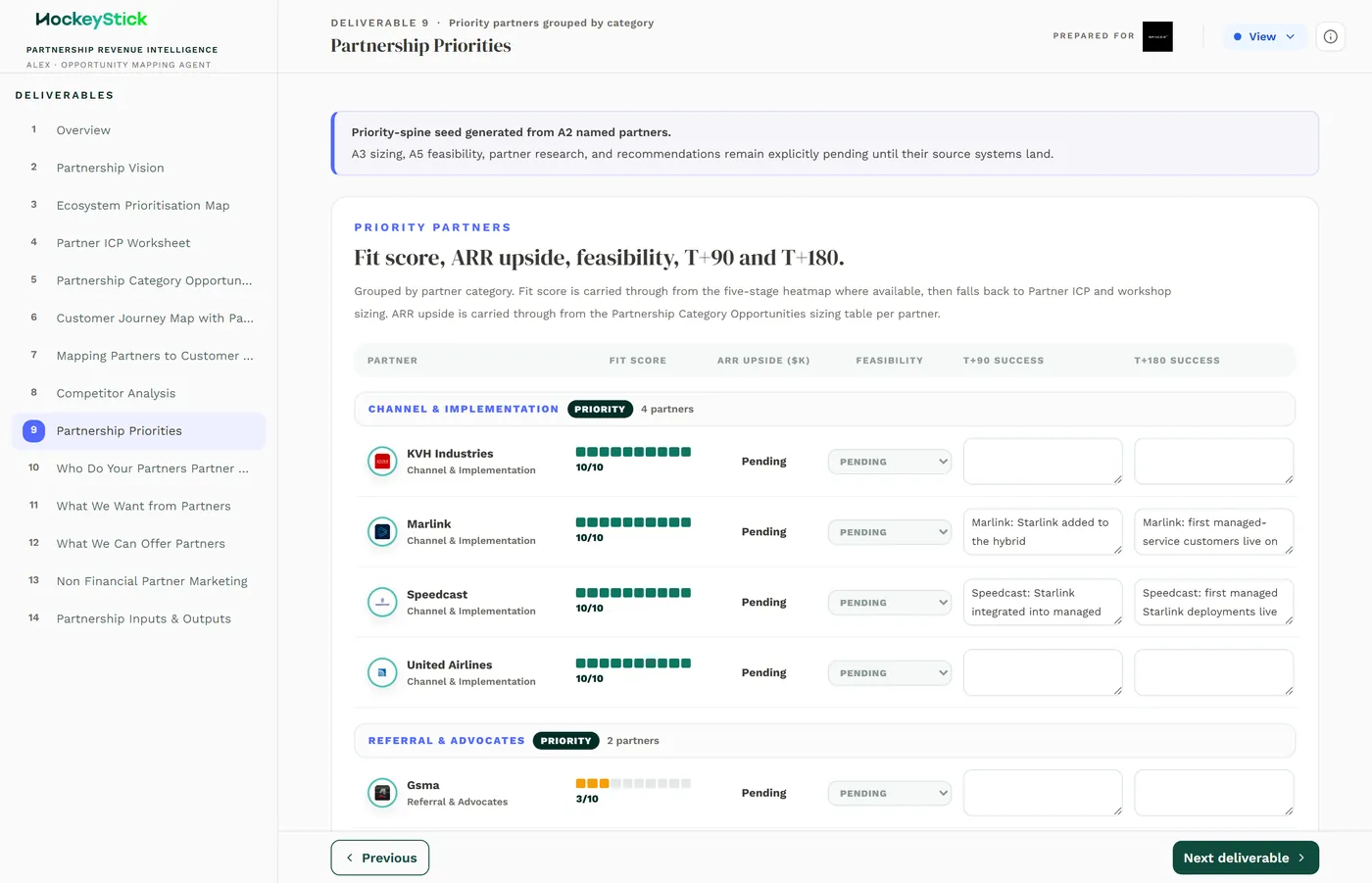
This page groups the client's priority partners by category and shows what each priority category looks like as a program. It is where the ICP scoring turns into a shortlist.
What it is
A DIAGNOSTIC page, generated by Alex on top of Sam's published Workshop Pack, the intake, and the decisions made in the Partner ICP Worksheet. Alex only runs after Sam's pack is published. The priority spine is seeded from the named partners on Sam's Ecosystem Prioritisation Map (the A2 named partners), then the ICP decisions roll up here.
What each section means
- The priority framing. Each priority is described by its fit score, ARR upside, feasibility, and a T+90 and T+180 view, so the client sees not just who to prioritise but how soon and how feasible.
- What each priority category looks like as a program. Rather than a flat list, the page shows each priority category as a program the client can stand up.
- The category groupings. In the sample these read as Channel & Implementation, Referral & Advocates and Technology & Integration, the same priority categories carried through the rest of Alex's pack.
- The seed. The priority spine is a seed generated from the A2 named partners; the ICP decisions then determine which partners are actually prioritised, held or rejected.
Reviewing it before publishing
- The priorities agree with the Partner ICP Worksheet decisions, a partner shown as a priority here should be a Prioritise or Invest in the ICP, not a Reject or Hold.
- The category groupings match the Prioritisation Map and Sam's ranking.
- Fit scores and ARR upside trace back to the ICP scores and the category sizing, no stray numbers.
- The T+90 and T+180 framing is realistic for the client's stage.
- The client's real name and real partners appear, no sample data.