
Opportunity Mapping (Alex)
Partnership Vision
The vision and strategic intent for the partner ecosystem.
Partnership Vision (Alex)
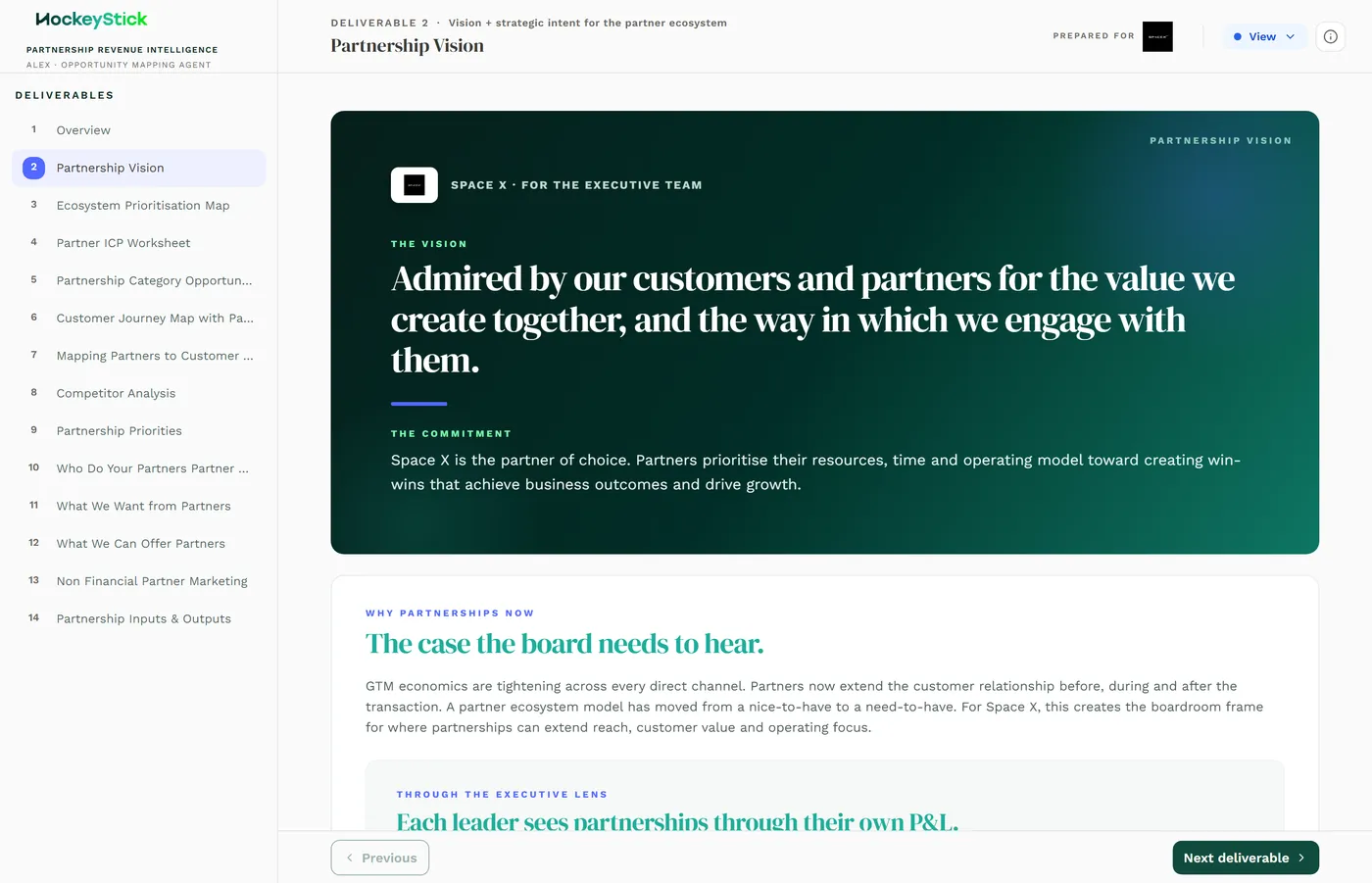
The Partnership Vision is the opening page of Alex's Opportunity Map. It frames the strategic case for the client's partner ecosystem in language a board would hear.
What it is
A REPORT page, generated by Alex. Like most of Alex's pack, it builds on Sam's published Workshop Pack (the priority categories that surfaced from the Ecosystem Worksheet) plus the client's intake. Alex only runs once Sam's pack is published, so if this page is missing or thin, check that Sam is published first. The page is LLM-drafted and consultant-editable.
What each section means
- The case the board needs to hear. The headline framing: why partnerships matter enough to warrant board attention for this client.
- Each leader sees partnerships through their own P&L. The vision is expressed through each C-suite lens so every leader sees their own stake:
- Chief Executive
- Chief Revenue Officer
- Chief Financial Officer
- Chief Marketing Officer
- The market shift. Supporting evidence that partners are expanding their services before, during and after the transaction, with cited external voices (for example Satya Nadella and Jay McBain) and market figures. It also frames partnerships as moving from a nice-to-have to a need-to-have, spanning people, processes, program and underlying technology.
Reviewing it before publishing
- Sam's pack is published, so the vision reflects the actual priority categories.
- The client's real name appears throughout, not a placeholder or the sample company.
- Each C-suite lens reads true for this client's situation, not generic boilerplate.
- Any external quotes or figures are left as drafted; do not invent or alter numbers.
- The tone is board-ready and matches the client's stage and industry.