
Opportunity Mapping (Alex)
Partner ICP Worksheet
Score partners on the four C's, understand the decision engine, and review it before publishing.
Partner ICP Worksheet (Alex)
The Partner ICP Worksheet scores each candidate partner against your client's ideal-partner profile and turns those scores into a decision. It is the most mechanical worksheet in the Align stage, so getting the inputs right matters.
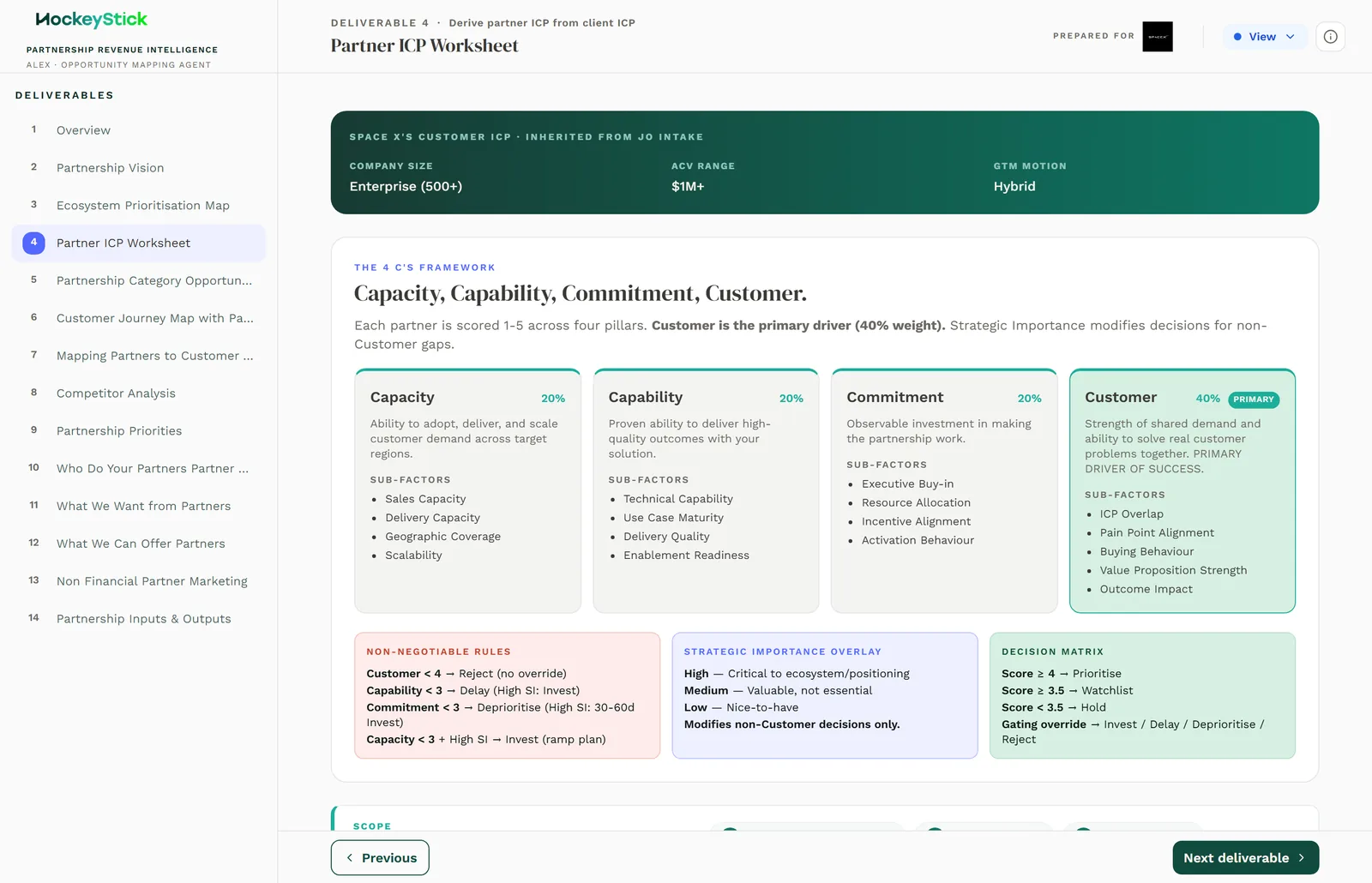
The four C's
Every partner is scored 1 to 5 on four factors. The factors are weighted, and Customer is the primary driver:
| Factor | Weight | What you are scoring |
|---|---|---|
| Capacity | 20% | Can they deliver? Sales capacity, delivery capacity, geographic coverage, scalability. |
| Capability | 20% | Are they good at it? Technical capability, use-case maturity, delivery quality, enablement readiness. |
| Commitment | 20% | Will they prioritise you? Executive buy-in, resource allocation, incentive alignment, activation behaviour. |
| Customer | 40% | Do they reach the right buyers? ICP overlap, pain-point alignment, buying behaviour, value-proposition strength, outcome impact. |
Score each C on the evidence, not on optimism. Use the evidence field under each C to record why, so the score is defensible in the client review.
The weighted score
The four scores combine into a single weighted score, S:
S = (0.2 x Capacity) + (0.2 x Capability) + (0.2 x Commitment) + (0.4 x Customer)Because Customer is double-weighted, a partner strong everywhere except Customer still scores poorly. That is intentional: the right capabilities aimed at the wrong customers do not build partner revenue.
The decision engine
The worksheet derives a decision for each partner. The rules run in order, and the first one that matches wins:
- Any of the four scores blank, no decision yet.
- Customer below 4, Reject. This is a hard floor and cannot be overridden.
- Capability below 3, Delay (or Invest if strategic importance is High).
- Commitment below 3, Deprioritise (or Invest if strategic importance is High).
- Capacity below 3 and strategic importance High, Invest (a ramp plan).
- Otherwise, decide by the weighted score S:
- S of 4.0 or above, Prioritise
- S of 3.5 to 3.9, Watchlist
- below 3.5, Hold
The strategic importance overlay
Each partner also carries a Strategic Importance flag that can rescue a partner from a soft gate (it never overrides the Customer floor):
- High, critical to the ecosystem or positioning. Turns a Delay, Deprioritise
or capacity gate into Invest with a ramp plan.
- Medium, valuable but not essential.
- Low, nice to have.
The overlay modifies non-Customer decisions only. A partner with Customer below 4 is Rejected regardless of how strategically important it is.
Completing it
- Add each candidate partner (name and domain).
- Score the four C's, using the sub-factors as prompts. Record evidence.
- Set Strategic Importance for partners that matter beyond their raw score.
- Let the decision compute. If you override a decision, record the reason.
Scores save as you set them; evidence and override notes use a Save / Revert row.
Reviewing before publishing
- Every partner is fully scored. A blank C means no decision.
- Customer scores are honest. Because Customer gates and double-weights, an
inflated Customer score quietly promotes a weak partner.
- Decisions read correctly. Spot-check a few: does the Reject / Invest /
Prioritise match what you would say out loud about that partner?
- Overrides are justified. Any manual override has a reason recorded.
- The priorities page agrees. Partner ICP decisions roll up into Alex's
Partnership Priorities, so check the two tell the same story before you publish.