
Workshop Pack (Sam)
Ecosystem Maturity Report
This diagnostic is AI-generated; here is how to sense-check and correct it.
Reviewing the Ecosystem Maturity Report (Sam)
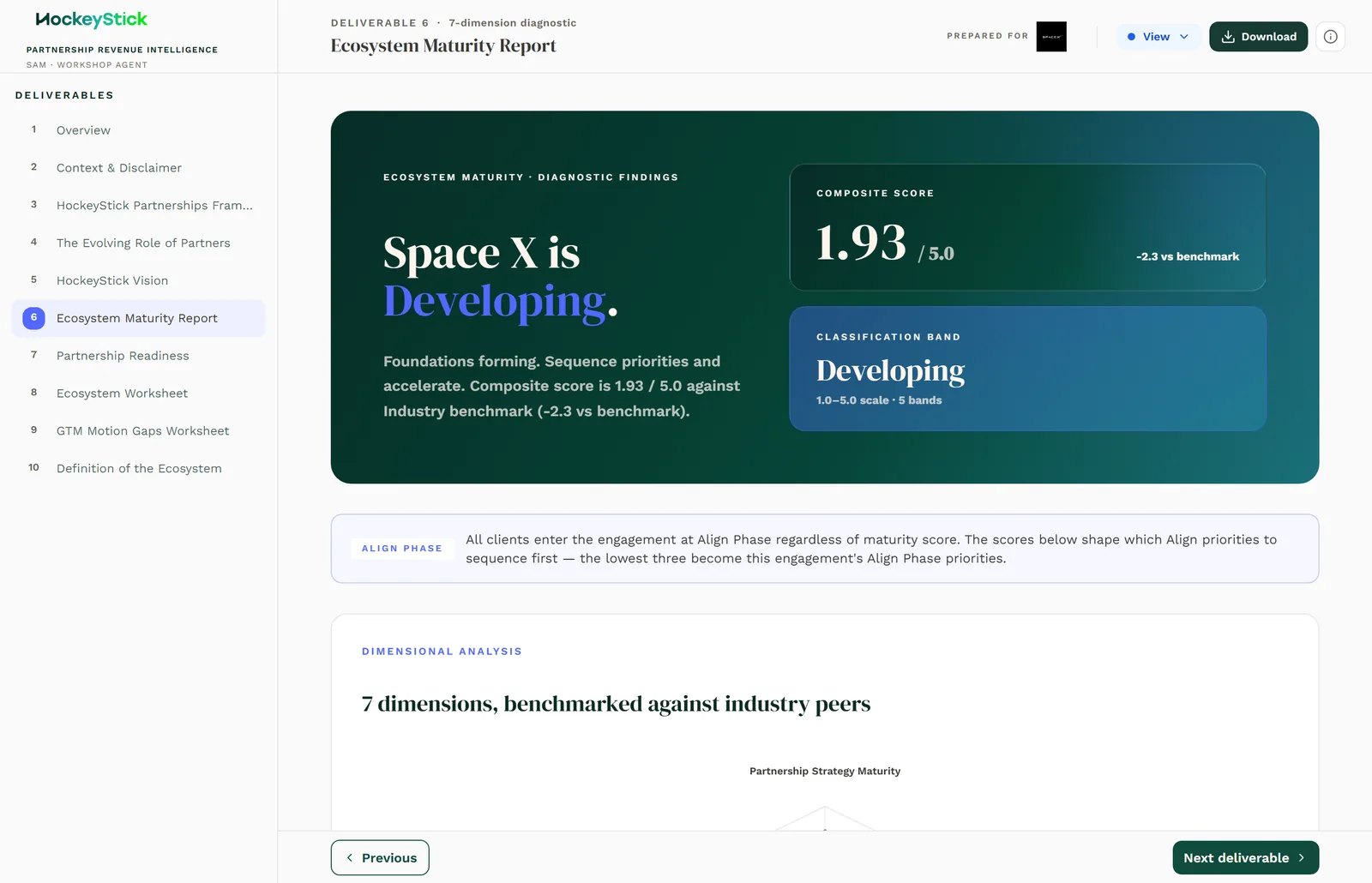
The Ecosystem Maturity Report scores how mature the client's partnership function is today. Unlike the worksheets, you do not hand-enter it: it is LLM-generated from the intake, then handed to you to sense-check and correct. Your job is not to build it, it is to catch where the model has over-read or under-read the evidence, and fix it before it ships.
It is generated, not entered
The report is drafted by the model from what the client told you at intake. It is editable: every dimension score and its rationale text can be corrected. Treat the draft as a strong first pass by an analyst who only read the intake, and who has not met the client. That is exactly where your review adds value.
The seven dimensions
Each dimension is scored 1.0 to 5.0:
- Partnership Strategy Maturity
- GTM Integration
- Ecosystem Coverage
- Executive Commitment
- Revenue Attribution and Measurement
- Product and Integration Readiness
- Operational Infrastructure
The 1 to 5 scale
The same rubric anchors apply to every dimension:
| Score | Anchor | Meaning |
|---|---|---|
| 1 | Nascent | Absent or ad-hoc. Nothing repeatable. |
| 3 | Established | In place and repeatable, not yet optimised. |
| 5 | World-class | Best in class, a genuine advantage. |
Scores 2 and 4 sit between the anchors. Score to the evidence: if the intake shows no revenue attribution at all, that dimension is a 1, not a diplomatic 3.
The overall score and bands
The overall is the mean of the seven dimensions, to two decimals:
overall = mean of the seven dimension scores (to 2 decimals)The overall maps to one of five bands, in order:
- Nascent
- Developing
- Progressive
- Mature
- World-class
Benchmark and priorities
Each dimension is benchmarked against peers by the client's funding stage, and shows a delta versus that benchmark. The top 3 Align priorities are the three biggest gaps versus benchmark (or the lowest three dimensions if there is no benchmark). This is why the benchmark matters: a dimension can score a middling 3 and still be a top priority if peers at that stage are all at 4.
How to review it
- Does each dimension score match the intake evidence? Read the rationale
against what the client actually said. A 4 on Executive Commitment with no executive sponsor in the intake is the model being generous; pull it down.
- Is the band right? Recompute the headline in your head. If six dimensions are
2s and the band reads Progressive, a score is wrong or the rationale is padded.
- Are the top 3 priorities the real gaps? They should be the biggest deltas
versus the funding-stage benchmark, not just the lowest raw scores. Check the three highlighted priorities are the ones you would actually raise with the client.
- Do the dimensions hang together? Weak Revenue Attribution usually drags GTM
Integration and Operational Infrastructure with it. If one is a 1 and its neighbours are 4s, question the outlier.
How to edit
Correct a dimension by adjusting its score and rewriting its rationale text to match. When you move a number, always move the words with it: an edited score with a stale rationale reads as a mistake in the client review. If your edit changes which dimensions have the biggest benchmark gap, re-read the top 3 priorities and confirm they still reflect the corrected picture.
Once corrected, this sits in the Sam workshop pack alongside the Ecosystem Worksheet.