
Opportunity Mapping (Alex)
Who Do Your Partners Partner With
The whole-ecosystem second-degree relationship map.
Who Do Your Partners Partner With (Alex)
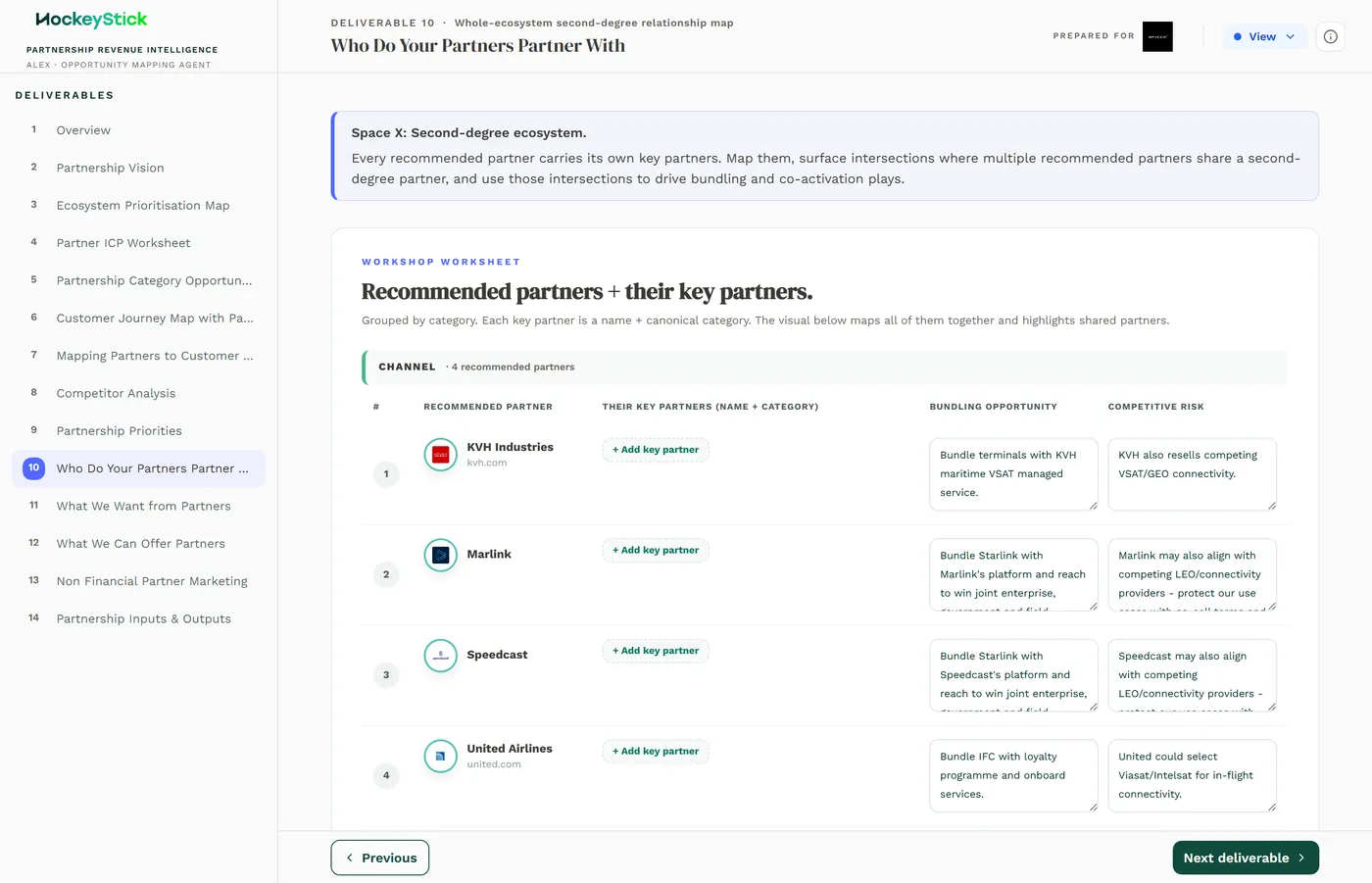
This page maps the second degree of the client's ecosystem: the recommended partners, and the partners those partners work with. It shows the reach the client can borrow through its shortlist.
What it is
A DIAGNOSTIC page (slug partner-relationship-map), generated by Alex on top of Sam's published Workshop Pack and the intake. Alex only runs after Sam's pack is published. It reads the recommended partners and expands each one to the partners it in turn partners with.
What each section means
- Recommended partners plus their key partners. The core of the page: each recommended partner is listed with the partners it partners with.
- The per-partner expansion. Under each recommended partner sits its own set of relationships. In the sample these read as entries such as KVH Industries, Marlink, Speedcast, United Airlines, Amazon Web Services, Cisco Systems, Cloudflare and Google Cloud, each shown with the partners they connect to.
- Second-degree ecosystem. The whole thing rolls up into a view of the client's second-degree ecosystem, the extended reach available through the shortlist rather than direct relationships alone.
Reviewing it before publishing
- The recommended partners match the shortlist on Partnership Priorities and the ICP decisions.
- The second-degree relationships are real and relevant to this client's space, not filler names.
- The client's real name anchors the map (for example "{client}: Second-degree ecosystem"), no sample company.
- The roll-up reads as reach the client could plausibly access, not a generic vendor list.